
Risk Management for Shorts: Position Size, Hard Stops, and Max Loss Rules
Short selling tests discipline more than almost any strategy. Price can rise without a cap, squeezes hit without warning, and borrow costs creep in. If you want to stay in the game, you need risk management for short selling that is simple, mechanical, and written down. This guide gives you clear rules for position size, hard stops, and max loss limits, so your account is protected when a trade turns ugly.
This playbook is for active traders in stocks, futures, or crypto. The examples below use stocks, but the same rules apply to any short with a defined stop. Read with a notepad handy, set your own numbers as you go, then commit to them.
Why Short Selling Needs Stricter Risk Controls
 Photo by cottonbro studio
Shorts blow up fast because your upside is capped and your downside is open. Stocks also gap up on news, halt on the way up, or trigger a squeeze when shorts rush to cover. Borrow fees add drag over time, and forced buy-ins can close a trade at a bad price.
Good news, you do not need to predict the next squeeze. You need rules that cap your loss, force exits, and keep your size small enough to think clearly.
Pillar 1: Position Size for Short Trades
Position size is your first line of defense. If it is wrong, everything downstream breaks. Here is a simple rule: risk a fixed percent of your account on each trade, then size shares by the distance to your stop.
The risk-per-trade formula
- Risk per trade: pick 0.5% to 1.5% of your account. Smaller is safer while learning.
- Stop distance: the gap between your entry and the price that proves you wrong.
- Shares to short: Risk per trade divided by stop distance.
Formula: Shares = (Account size x Risk percent) divided by (Stop distance per share).
This mirrors the familiar 1% or 2% risk approach used by many traders. If you need a refresher on the math behind fixed fractional risk, review the simple example in CME Group’s overview of the 2% rule.
Volatility and borrow constraints
Reduce size if the stock has wide spreads or frequent halts. If the borrow is tight or fees are high, assume you might hold longer than planned and reduce size again. If your broker limits shortable size or you see frequent buy-ins, size down to what you can exit in one or two prints without slippage.
Quick examples
Assume a $50,000 account and 1% risk per trade, so you can lose up to $500 on one idea.
- Example A: Short at 24.80, stop at 26.05, stop distance 1.25. Shares = 500 divided by 1.25, so 400 shares.
- Example B: Short at 12.40, stop at 12.90, stop distance 0.50. Shares = 500 divided by 0.50, so 1,000 shares.
A small table helps frame this quickly.
| Account Size | Risk % | Risk $ | Entry | Stop | Stop Distance | Shares |
|---|---|---|---|---|---|---|
| $50,000 | 1.0% | $500 | 24.80 | 26.05 | $1.25 | 400 |
| $50,000 | 1.0% | $500 | 12.40 | 12.90 | $0.50 | 1,000 |
| $50,000 | 0.5% | $250 | 18.10 | 18.70 | $0.60 | 416 |
Round down your share count to the nearest round lot or to a size you can exit fast without chasing.
If you prefer even tighter control, the 1% rule is a common starting point. This quick guide on where to place a stop and how the 1% rule promotes discipline can help you set a base risk level.
Pillar 2: Hard Stops That Actually Trigger
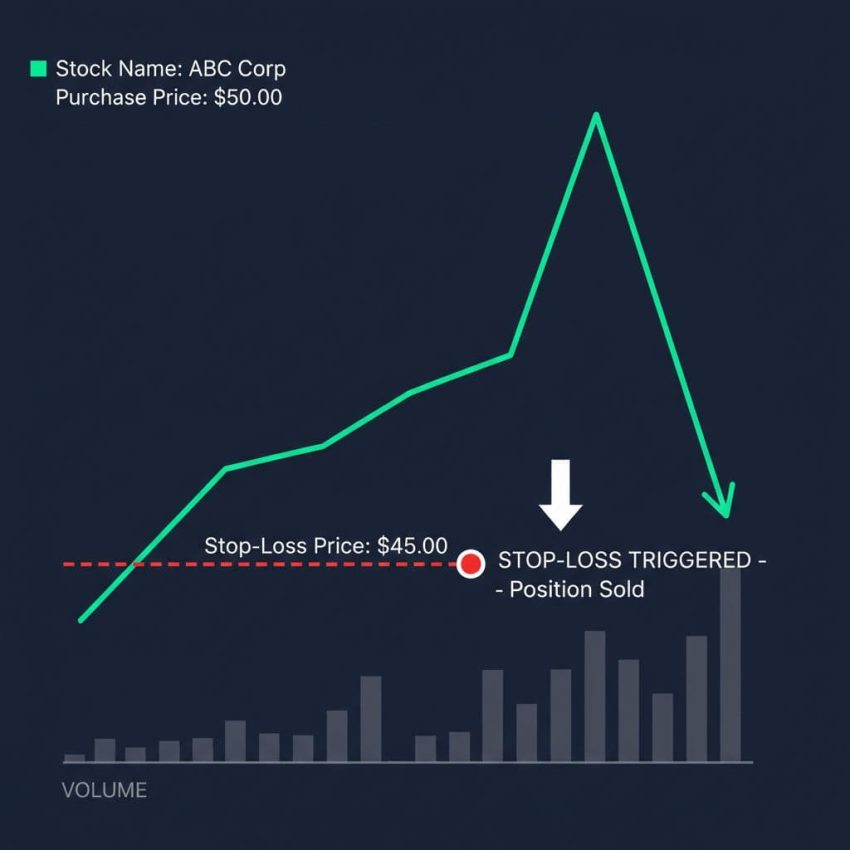
A soft stop is a wish. A hard stop is your insurance policy. You need a stop that triggers, not one you negotiate with after the stock spikes.
- Use stop market orders when the stock trades smoothly. They exit you at the next available price once triggered.
- Use stop limit orders with caution. In a fast squeeze, a stop limit can skip fills and make a small loss turn into a disaster.
- Place stops at price levels that break your trade idea, not at round numbers only. Let the chart tell you where you are wrong.
If you are new to the specifics of stop order types and why to use them, this primer on how stop-loss orders work is a solid reference.
Where to place stops on shorts
- Above a recent high that defined the trend shift.
- Above a key level like premarket high, VWAP reclaim, or a multi-day pivot.
- Far enough away to avoid normal noise, close enough to cut the loss.
Some traders adjust stops based on market condition, like using a wider stop in choppy periods then cutting size to match. Here is a practical overview of stop-loss placement strategies that pairs well with the position sizing formula above.
Gaps, halts, and slippage
Stops cannot protect you from every gap or halt. Assume slippage on hot stocks. The solution is smaller size, faster exits, and no doubling down. If you want extra protection during news events, skip entries into scheduled catalysts or put your stop tighter and size smaller.
Pillar 3: Max Loss Rules That Stop the Bleed
Max loss rules protect your week and month when a bad day spirals. Write them, then automate them if your broker allows. If not, enforce them yourself.
- Per-trade max loss: equal to your risk per trade. If hit, you are out. No re-entry unless a fresh setup appears and the loss resets.
- Daily max loss: 2 to 3 times your risk per trade. If your risk is $500, your daily cap could be $1,000 to $1,500.
- Weekly max loss: 2 to 3 times your daily cap. If hit, reduce size for the next week.
The logic is simple. Keep bad days from turning into bad weeks. For a structured refresher, read the section on per-trade and daily loss caps in this guide on risk management for day traders.
Tie your max loss to market condition. In volatile weeks, take the lower end of the range. In quiet weeks, you can be closer to the middle. Your goal is to trade again tomorrow with a clear head.
The Short Seller’s Execution Playbook
Use this checklist before every entry. It keeps your rules front and center.
- Define your thesis: Why short here, and what would prove you wrong.
- Mark your stop: A price on the chart, not a feeling.
- Compute shares: Account size times risk percent, divided by stop distance.
- Check borrow and fees: If borrow is tight or fees are high, reduce size.
- Place the stop order immediately: No waiting for later.
- Set a profit exit plan: Scale at first target, move stop to break even if price confirms.
- Respect the daily max loss: If hit, shut it down.
Advanced Considerations for Shorts
Short selling has extra moving parts. Plan for them upfront.
- Borrow costs: These fees vary, and they stack over time. If your trade is a multi-day hold, include borrow cost in your risk. Many traders favor intraday shorts to avoid fee drift.
- Buy-ins: If shares get recalled, you can be forced to cover. Have a contingency for a quick exit that does not exceed your max loss.
- Liquidity and slippage: Thin names can move on air. If spreads widen around your stop, your loss can grow. Reduce size on thin stocks and set realistic targets.
- News and catalysts: Earnings, FDA updates, and M&A rumors can blow past stops. Trade smaller or skip entries before scheduled events.
- Volatility filters: When the stock trades like a fire hose, consider half size and wider stops. This keeps the risk per trade constant.
If you want a simple framework for risk caps across accounts and strategies, the math in the 2% rule explanation is easy to map to short trades.
Sample Short Trade Plan
Let’s turn the rules into a one-page plan you can copy and edit.
- Account size: $50,000
- Risk per trade: 1%, so $500
- Daily max loss: $1,000
- Weekly max loss: $3,000
Setup: Gap up into daily resistance with heavy volume, then fails VWAP. Entry only after a lower high forms under the premarket top.
Trade example:
- Entry: Short at 28.60 after the lower high.
- Invalidation: Break and hold above 29.40.
- Stop: 29.45 to allow a tiny buffer.
- Stop distance: $0.85.
- Shares: $500 divided by $0.85, so 588. Round to 500 shares because liquidity is only average.
- Profit targets: First scale at 27.90, second at 27.20, final trail into 26.80.
- If first target hits and price holds under VWAP, move stop to 28.60, which locks the risk to near zero.
If price snaps back above VWAP with volume and your stop hits, accept the loss and reassess. No re-entry unless a fresh lower high forms and the daily loss limit allows another trade. If daily loss reaches $1,000, shut it down for the day. This is what protects your week.
How to Place Stops That Survive Noise
Stops get hit for two reasons: you set them where everyone else did, or you ignored the stock’s natural rhythm. Here is how to improve:
- Place stops beyond structure: The last swing high on a 1 to 5 minute chart, not the exact pivot.
- Avoid even numbers: Crowd stops at 25.00 get tagged. Use 25.07 or 25.13 instead.
- Read the tape: If you see repeated soak at a level, assume stops above that level get swept. Place yours beyond the sweep zone.
- Respect the time of day: Opens are noisy. Use smaller size with wider stops early, or wait for the first pullback.
For more ways to think about stop placement across conditions, see these practical ideas on stop-loss placement strategies.
Position Sizing With Volatility Anchors
Volatility changes fast, so your size should flex. One simple approach is to anchor size to recent range.
- Use average true range on a short time frame to estimate normal wiggle.
- Set your stop outside that wiggle, then compute size from your fixed risk.
- If ATR doubles, your stop gets wider, so shares drop. Your risk stays the same.
This method keeps you consistent during calm days and wild days. If you prefer rules of thumb, starting with a 1% risk per trade and adjusting as your edge improves can work well. A short explainer on the 1% rule and stop placement gives a clear baseline.
Hard Stops for Gaps and Halts
You cannot always control fills, but you can control exposure.
- Avoid adding size into a halt. You do not know where it reopens.
- If a stock halts up against you, your next decision is to protect the account. Plan to lighten or exit on reopen if price action confirms the squeeze.
- Use smaller size on names with frequent halts, or skip the trade.
If you are still deciding between stop types, this overview of stop-loss orders and their trade-offs clarifies why most short sellers prefer stop market orders in fast moves.
Put It All Together: Your One-Page Short Risk Sheet
Print this and fill your numbers.
- Risk per trade: % of account, max $
- Daily max loss: $___
- Weekly max loss: $___
- Default stop style: stop market or stop limit
- Default entry rules: structure, VWAP, time of day
- Borrow check: fees, availability, forced buy-in risk
- Size math: shares = risk dollars divided by stop distance
- After-entry tasks: place stop, set alerts, map targets
- Kill switch: if daily loss hits cap, stop trading
If you want a deeper framework for setting these caps, scan this comprehensive overview on risk management for day traders. It aligns well with the plan above.
Conclusion
Short selling can be hard on your mind, but a simple plan creates control. Set position size with a fixed risk number, use hard stops that actually trigger, and follow max loss rules that end bad days early. Protect your capital first so you can trade clean tomorrow. Write your numbers, commit to them, and let the rules do the heavy lifting.